

Dear Math Meets Money Readers,
For a while now, I’ve been monitoring a slow but undeniable progression in the global financial and monetary landscape. Step by step, the signals have become harder to ignore. Each one alone might seem like a blip, but taken together they outline a clear direction — a system under stress, shifting in ways that echo past turning points.
Today, we moved further down that path. Here are five of the most telling signals:
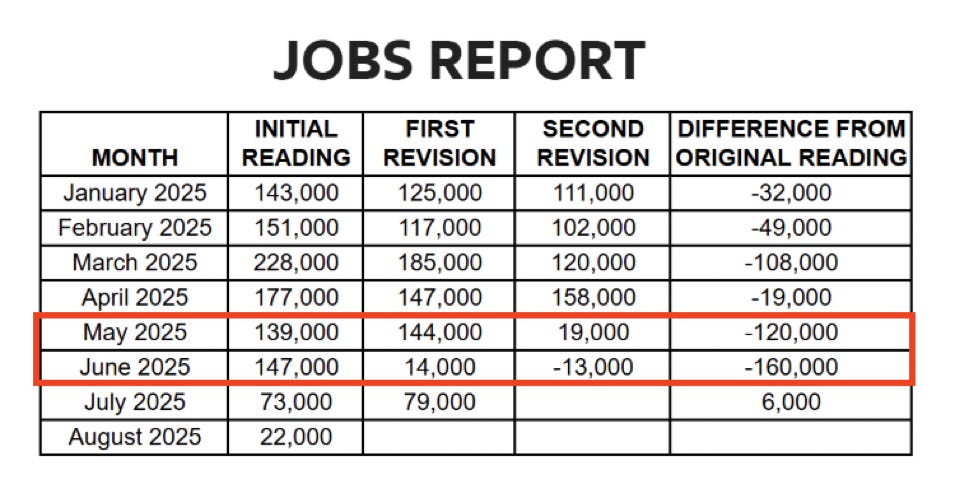
1) The Labor Market — a second downward revision for the summer jobs data landed this morning,
2) The Bond Market — We also saw a steepening at the long end of a V-shaped Yield Curve for U.S. treasuries:
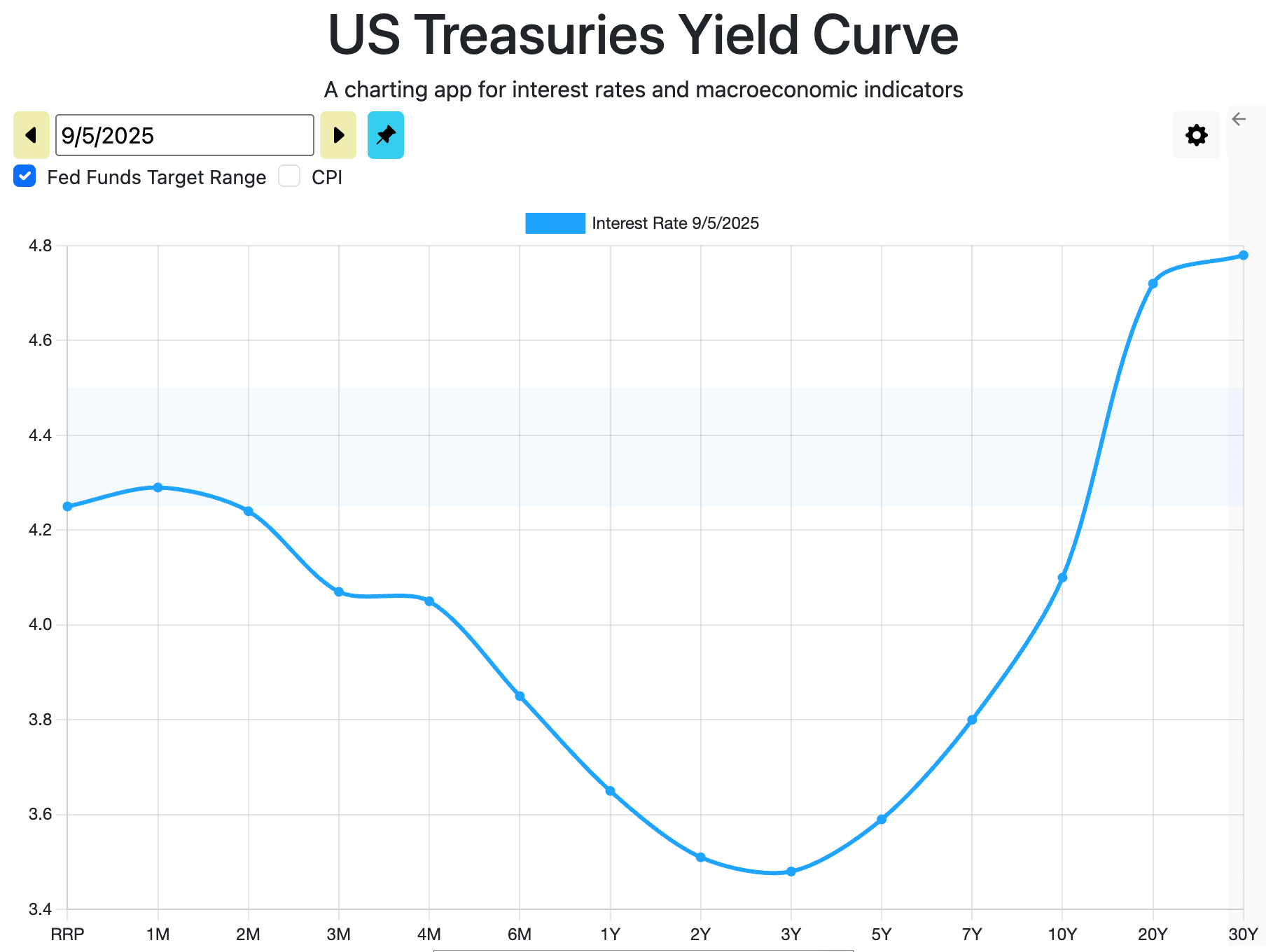
Normally, when a recession is looming, the yield curve inverts (sloping downward to the right), signaling expectations of lower future interest rates. The current steepening at the long end — covering 5- to 30-year maturities — shows investors remaining anchored to high yields; either pricing in persistent inflation expectations in the long run or heightened volatility risk as the Fed loses independence. This mirrors what is seen across the West today, and echoes the behavior that followed the 1929 Crash, which preceded the Great Depression.
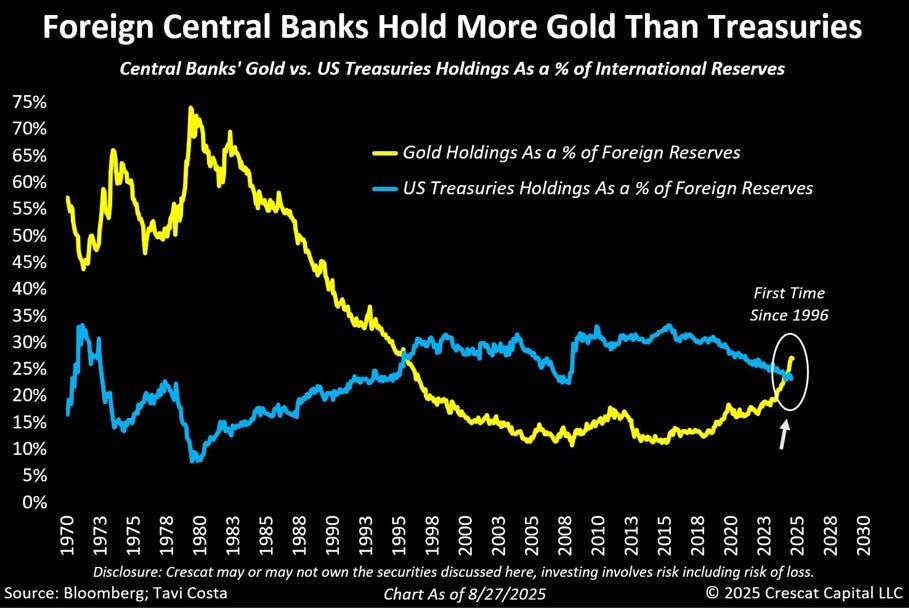
3) Central Bank Reserves — this comes alongside an unmistakable upward trend in foreign bank gold reserves that seems to appear on my newsfeed almost daily.
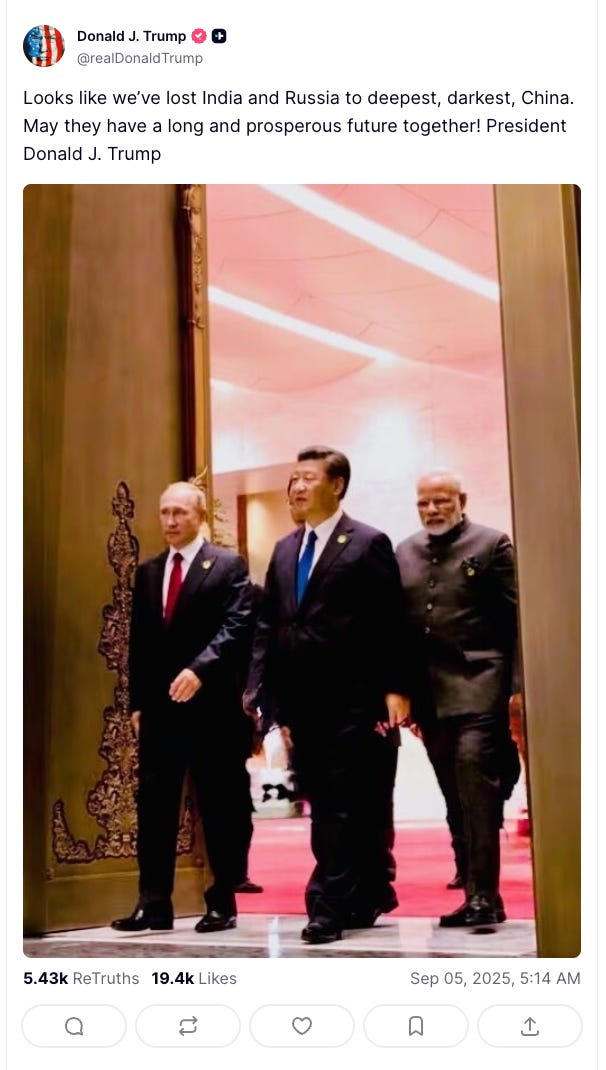
4) Geopolitics — just this morning, the Leader of the Free World publicly turned his back on India and Russia after the SCO (a subset of BRICS+) summit in Shanghai this week.
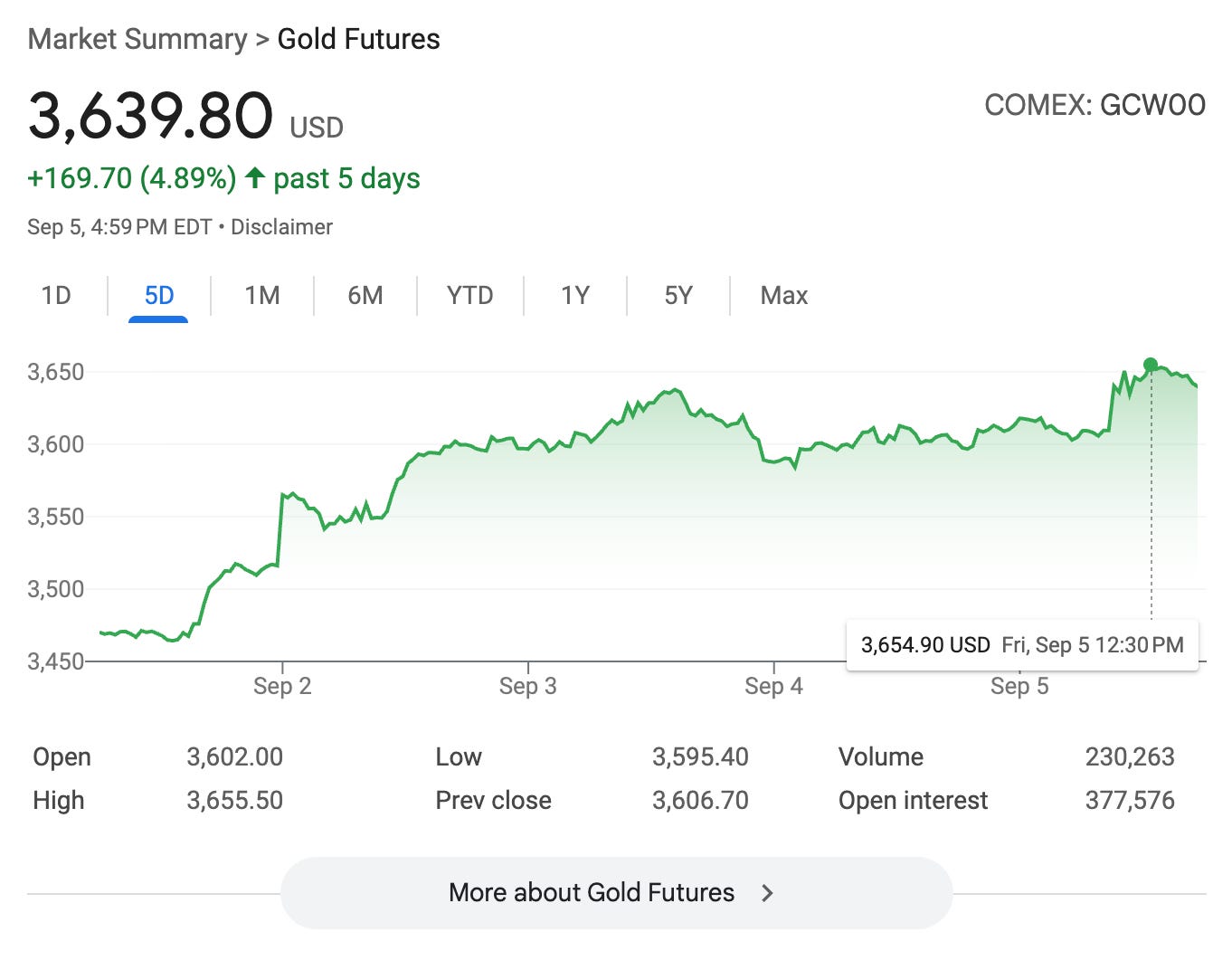
5) Demand for Gold - meanwhile, gold futures surged to another record high for the year, moving past $3,600/oz for the first time in history:
With these signals, among many others, screaming at us — I think it’s about time that I lay out what I’ve learned in the process of transitioning my mindshare away from physics and into the world of finance and monetary policy over the past 12 months.
Why Me?
First, it’s worth asking, why did I become so interested in this a year ago? And why do I think I have a pretty good handle about where things are going?
Well, because the future debt crisis will not be driven primarily by an overabundance of supply or demand that is typical in private market debt cycles (though, trust me, there will be plenty of that) — rather the impending sovereign debt crisis will fundamentally be driven by what happens when the tape you use to measure the economy expands or contracts at a pace that is destructive to the financial economy of stocks and bonds. In this case, the ruler is the US Dollar and Treasuries — what we’re seeing in practice is particle physics play out in the macroscropic world.
And when you are an ex-particle physicist like me, you get really really good at identifying signal from noise when the measuring tape used to observe your system can’t be trusted. Every physicist worth their salt knows that too much trust in your coordinate system, in this case the US Dollar, is a great way to be deceived by reality.
This perspective was my starting point over a year ago when I started this newsletter; and in the process of diving deep into the history and mechanics of rapid shifts of currency dominance, I’ve realized that the good information on this topic is frustratingly scattered and decentralized. The last time the world faced this kind of systemic shift was well over a century ago. There is no central body of literature, no cohesive narrative, and no one alive to tell us what happens next.
As a result, most of the commentary on what’s coming is, frankly, misinformed. Many legacy institutions — including, it seems, the Fed — are trying to apply the lessons of 1987, 2001, 2008, or 2020 to a situation that is fundamentally different. They are pattern matching to the wrong debt crisis.
In contrast, some quiet corners of FinTwit & Wall Street are VERY AWARE of what’s about to happen — but it’s sadly delivered at a level of expertise that is hopelessly inaccessible to normies that didn’t do an internship at Goldman Sachs or Citadel.
So, I’m going to do my best to make it much more accessible.
In Plain English
Here’s what most of the informed FinTwit & Wall Street chatter is saying (roughly):
For most of the past 80 years, the bedrock of the global financial system has been the U.S. dollar and U.S. Treasury bonds. After the Volcker Shock in the early 1980s, the dollar was hardened into a true safe-haven asset, supported by a government balance sheet carrying relatively low debt.
This stability gave the Federal Reserve extraordinary freedom to absorb private debt crises—the natural rhythm of the business cycle. Policymakers could issue Treasuries that investors trusted as stable, safe assets, allowing the U.S. to weather violent financial storms since the end of World War II.
That foundation no longer holds. The U.S. fiscal position is far weaker, and foreign policy is trending toward isolationism, putting sustained downward pressure on dollar dominance. This fiscal stress is already evident in the bond market, where an uncharacteristic V-shaped yield curve signals a profound shift in the system’s plumbing—and deep fragility, as bond traders grow reluctant to trust the long end of the curve.
As I said, the narrative is slowly emerging, but it can be found in the depths of academic papers and obscure geopolitical analysis (thanks, Ray Dalio, you crazy dawg). So, to help make sense of it all, I’ve decided to pull together everything I’ve learned into a five-part series called:
The Great Reset: A User’s Guide to the New Monetary Order
My primary goal is to centralize the best information out there and provide a cohesive, professional guide to what’s happening — and what you, a holder of US dollars and user of credit backed by the stability of US Treasuries, can do about it. This newsletter series will range from the historical context to practical analysis — all aimed at helping you better understand the decade to come.

The Game Plan
Here’s what to expect for this five-part newsletter series I plan to push out in the coming months:
Part 1: The Evolution of Money Printing: A journey through gold’s historical role in monetary policy, the transition to fiat and paper promises, and the mechanisms by which central banks actually print money. To reverse course, the next Fed Chair will likely need to adopt an unconventional, and deeply unpopular approach to monetary policy.
Part 2: The Petrodollar System: A high level overview of how the rise and fall of dollar dominance is built on top of energy commodities. The preeminence of the US Dollar is the global oil trade, indirectly makes the West structurally short gold as a reserve asset to protect its sanctions authority; and in turn invites China to hoover up global supply of gold.
Part 3: A Japanese Energy Crisis is the First Domino: This archipelago in the Pacific is ticking time bomb. Rising Nationalism, poorly timed stimulus, and a deadly carry trade that could unwind if poked. As noted above, demographics is destiny, and Japan is ground zero.
Part 4: Demographics is Destiny: A taste for why this time, it really is different: aging populations and declining birthrates will shape the future of balance sheet management. Given where we are today, there really is only one viable path: dramatically increase productivity, or forever be caught in a cycle of subsidizing elder care with a shrinking population.
Part 5: War Gaming a Return to Hard Currencies: A historically informed roadmap on how a government re-bases its money supply to real assets, and what happens when it’s done right or wrong; and whether they decide to collaborate with allies, or go at it alone. Most importantly, this will be a How To guide for what you should expect as the fiscal drama unfolds.
I’m also intend to include a list of the books, academic researchers, and resources that have helped shape my thinking on this topic. My hope is that this series will serve as a foundational resource for anyone trying to navigate the next decade — and not have our savings wiped out by someone else’s mismanagement of sovereign debt.
If you know someone who might find this series useful, please share it:
If this sounds interesting, and you’d like to follow along, be sure to subscribe to get each part as it’s published:
Finally, since many of you are new, please feel free to send me a message if you have any editorial feedback, or have your own opinions on the topics you think I really need to cover:
Seriously — I will respond to anyone that reaches out. The more user feedback, the more topical these future newsletters will be.
Stay tuned.